

I remember a line in the movie ‘Girl, Interrupted’ where Vanessa Redgrave explains the meaning of the word ‘ambivalence.’ It’s not something you don’t care about — which is how most people think of the word — it’s actually something you feel strongly about in conflicting, contradictory ways. This post is about photos of mine that inspire that type of ambivalence from me — photos I love and hate at the same time.
I have a ‘secret’ bin of photos in my Lightroom Library, which are the ones that I can’t stop thinking about, yet have doubts whether they are actually good — or at least ‘good enough’. On that note, ‘doubt’ is probably a better word than ‘hate’ for these photos. They have some quality or content that I find special, but at the same time either a technical flaw or an inner fear that they are just ordinary. So I have held back from sharing them publicly, until now.
Some readers/viewers may like some of these photos, others may find them unworthy of being in a photography blog. I’ve had the same exact photos from a recent post dismissed as completely unsuccessful by one intelligent & experienced reader and praised as ‘textbook level’ images of their type by another sophisticated regular contributor on 35mmc. My feelings about the photos in this post have a similarly complex brew. With some inspiration from fellow 35mmc contributors Alexandre Kreisman and David Pauley, I have decided to lean into my doubts and discomfort to share them here. I’d be very happy to hear critiques of what you like and don’t like and/or what you would do differently to make any of these photos better!
Welcome to the Bin of Ambivalence, presented in chronological order, based on when they were shot…

This was in Canada shortly after I started teaching myself to use the Hasselblad. It feels tantalizingly close to something I’d print. I love the mood of families casually enjoying a summer Saturday afternoon in the Canadian Rockies with their dogs. As a group shot with nice layers of depth and a dramatic setting on a bright sunny day, this shot would look great if everything was sharp, like one of Slim Aarons’ fantastic tableaus. I don’t mind the action-related motion blur of the foreground boy and his dog, in fact I love it, but nothing else is quite as sharp as it should be in medium format with a legendary Zeiss/Hasselblad lens. My diagnosis is handheld motion blur, possibly ‘enhanced’ by the mirror slap of the Hasselblad. I also think the composition would be better if I had allowed a fraction of a second more for the boy to be fully inside the frame, not to mention leveling the camera. There is also a pronounced blue shift, which may be from shooting at high elevations without a UV filter, or from the home lab where it was processed (no pro lab in the area) or perhaps a combination of both.
But I still like to look at it; it makes me think about summer afternoons when I was that boy’s age.
NOTE: there may be relatively simple fixes in post production for some of these photos, but my early attempts at things like color correcting or selectively boosting or lowering exposure within a frame have tended to make things rapidly worse as opposed to better. Someday I may invest some time and energy into getting stronger at Lightroom or Photoshop, but for the moment, I’m kind of focused on getting stronger negatives in camera and only do a couple of simple ‘slider’ manipulations in Lightroom, like exposure and blacks, and occasionally cropping.

Something about this image evokes a memory or a dream of a lazy warm summer afternoon. This is another early effort where I definitely missed focus, but I think that softness is part of why it feels a little dreamy. Here I love the colors of the water in shadow & light, the warmth of the tan slate, and the inviting navy & white pool ‘floaties’ — it feels like something I’d see through squinted eyes waking up from a nap in the sun. More than once I’ve thought of making a small print to have in our house, but keep talking myself out of it.
That may be because when I get right down to it, it feels like a run of the mill mistake. Knowing that the focus issue was not an intentional creative choice is part of what holds me back. That being said, I’m not sure it would be all that interesting if it were perfectly sharp. The focus problem may have been mechanical; this was one of the final rolls I shot on my son’s M2 before I had it CLA’d to deal with some of the technical problems that were coming up frequently with that camera. The camera works fine now but this shot has stayed in the Bin of Ambivalence.
I look at it now and again when I’m going through my library, pause a bit wistfully and move on.

This was one of my very first attempts at doing a street portrait. I saw this young woman dressed very nicely for a photo session with another photographer on the main high street of Banff, Alberta. She was nice enough to agree to a photo for me, but I was a little too nervous in the heat of the moment and her lovely aura to think much about the composition and left a traffic barrier in the frame blocking the foreground and didn’t bother to include the peak of Mount Rundle that is just edging out of the top of the frame. Had I taken even a brief moment to think about the framing, I could have taken a step or two to the left, lowered the camera a couple of feet and tilted up to get the peak of the mountain. I think I would keep the landscape orientation, as I like all of the converging triangles of the street in perspective, the buildings and Mt. Rundle, but maybe I’d back up a couple of steps for a head to toe shot of the young woman against the mountain backdrop. And if I were shooting it now, I would take a wide shot as well as a couple of tighter closer sizes as long as she was up for it, which I find most people are once you engage with them. As it is, it’s something of a lost opportunity, but also a bit of a marker on my learning curve shooting street portraits.

On this shot I was testing out a very well-used collapsible 90mm Elmarit f4 that was a gift from a friend. I had some Cinestill 400D in the camera, and found the muted colors and low contrast very interesting. This roll sparked my interest in the different qualities & looks of vintage lenses, which has grown into a major aspect of my ongoing exploration of analog photography. I had ideas of taking a deep dive into that Elmarit to see if I could do anything clever or creative with that unusual look. But I haven’t followed up with the idea, partly because I got interested in shooting black and white, and further, on closer inspection I realized that particular copy of the Elmarit has a fair amount of internal haze. Also, I don’t really gravitate to shooting with a 90mm. On the rare occasions I do, I have another 90mm (the Elmarit f2.8 ‘rigid’) that is a stop faster, in much better condition and has great sharpness, contrast & color rendering.
I do like this photo a lot, but I think it might be because of my fondness for the subject, a friend from the crew on the project I was doing in Canada. And maybe one of these days I’ll revisit the idea of shooting some creative experiments in color!

I love the moment this shot captures, with an ice climber hanging suspended in the air. By this time, five or six months after that summer shot in Canmore, my shooting technique with the Hasselblad had improved to the point where I was retracting the mirror to minimize any camera shake due to the mirror slap, and this image is satisfyingly sharp. There is something very interesting about the quality of the color and light in this shot, the mix of warm sunlight against the blue ice feels almost like mixing tungsten and daylight. Possibly as a result of this interesting lighting/color mix, it really has a ‘film’ feel to me and feels like it could have been taken a year ago, or in the 1970’s when the camera and lens were new.
I like that vintage look, but I’ve never settled on the right exposure level in Lightroom to avoid either blown out highlights on the sunlit ice or losing most detail in the shadows. I was new to using a spot meter at that time and took readings on both shadows and highlights without yet knowing how dark and bright things look outside the ‘mid table’ section of the zone scale. There is detail in both areas of the negative, but I guess the dynamic range of the film is actually a little beyond what looks good on a digital scan. Perhaps a skilled Lightroom artist could arrive at a more perfect result or do the digital equivalent of dodging and burning to get to a more satisfying and balanced image. With my minimal skills, I decided to prioritize the most interesting element of the photo for me, which is the hanging climber, leaving the safety spotter in a bit of shadowy murk at the bottom of the frame and some blown highlights on the sunlit ice.
Still, I think it’s a cool shot that has a bit of narrative and drama to go along with the vintage film feel. Good enough to enjoy when I look at it, but not quite good enough to print or publish until a post like this.

This was early after my return to New York from Canada, and I was trying to shift gears creatively to shoot in a new environment with different challenges and opportunities. Coming out of shooting mostly landscapes for 6-8 months, I think my brain was still tuned in that direction, and my shooting position was a little more suited to getting a shot of the Lower Manhattan Skyline when I noticed an interesting little moment happening with a young woman posing for a photo near the edge of the East River and grabbed a quick snap. On the plus side I liked the energy of her pose and it is technically much stronger in terms of focus, sharpness and color accuracy than that very early shot in Canmore. So, while there are nice elements within the shot, it really doesn’t hold together — the scale of the main action is way off and much too small. The skyline and the tops of the buildings are cut off and I think I should have either avoided or fully included the little in-progress scene on the right side of the frame. I don’t feel like this one has the kind of narrative appeal or visual cohesion of the shot in Canmore, let alone a Slim Aarons photo — it feels a bit like some random unconnected activities as opposed to a telling moment. If I had it to do over again, I would have repositioned much closer to the young woman and her friend and made that the shot — but the moment was over and they moved on more or less as soon as I took the photo.
This shot is a relic from my learning curve of shooting people in NYC — at that time I was trying to capture moments without approaching or engaging with the people I was shooting, and most of the results were pretty uninspiring and uninteresting, and almost all of them much too far away from the subject.

It was the tail end of the winter of 2025 and NYC was finally starting to warm up a bit. I wanted to work on my NYC street shooting with the M3. I thought some photo walking in Manhattan would be a good start and thought it would be fun to take the East River Ferry and maybe grab a couple of scenic shots of NY Harbor and the Manhattan skyline on the way over. Just as I was boarding the boat, and before I had a moment to organize myself, this small professional model shoot unfolded right in front of me. As so often happens, many of my favorite shots come when I have other plans. I was excited to see the photographer was using a Rolleiflex and shooting film and made some halfhearted attempts to engage with them as a fellow photographer using analog equipment of a similar vintage. But they were busy working and pretty much ignored my presence. The boat ride across the East River is only about 10 minutes, so they didn’t have time to spare for an enthusiastic amateur.
I couldn’t resist a bit of ‘piggybacking’ and grabbed a couple of shots of their shoot. I really like the moment I caught here and am pretty happy with the framing & composition that feature the model and the photographer in action on a moving boat with the East River and Lower Manhattan as the backdrop. But like the shot in the icy canyon, I’ve struggled to find a happy exposure that works for two subjects of interest in a photograph that are in very different light. I also think this was before I got in the steady habit of using a lens hood for exterior daylight shooting, which probably would have helped with some of the flaring around the model. I’ve gone back and forth on the right Lightroom exposure settings on this photo many times, including for this post; to get a good level on the photographer, the model ends up with blown highlights on her hair and face, if I dial back to get a better exposure on the model, the photographer almost disappears in the shadows cast by the boat’s upper deck. For the moment have settled on settings that have enough detail on the photographer that you can tell what’s going on, while living with some ‘radiance’ around the model as the right compromise.
I think this is another ‘close, but no cigar shot’ with some very nice elements, but not quite up to snuff technically.

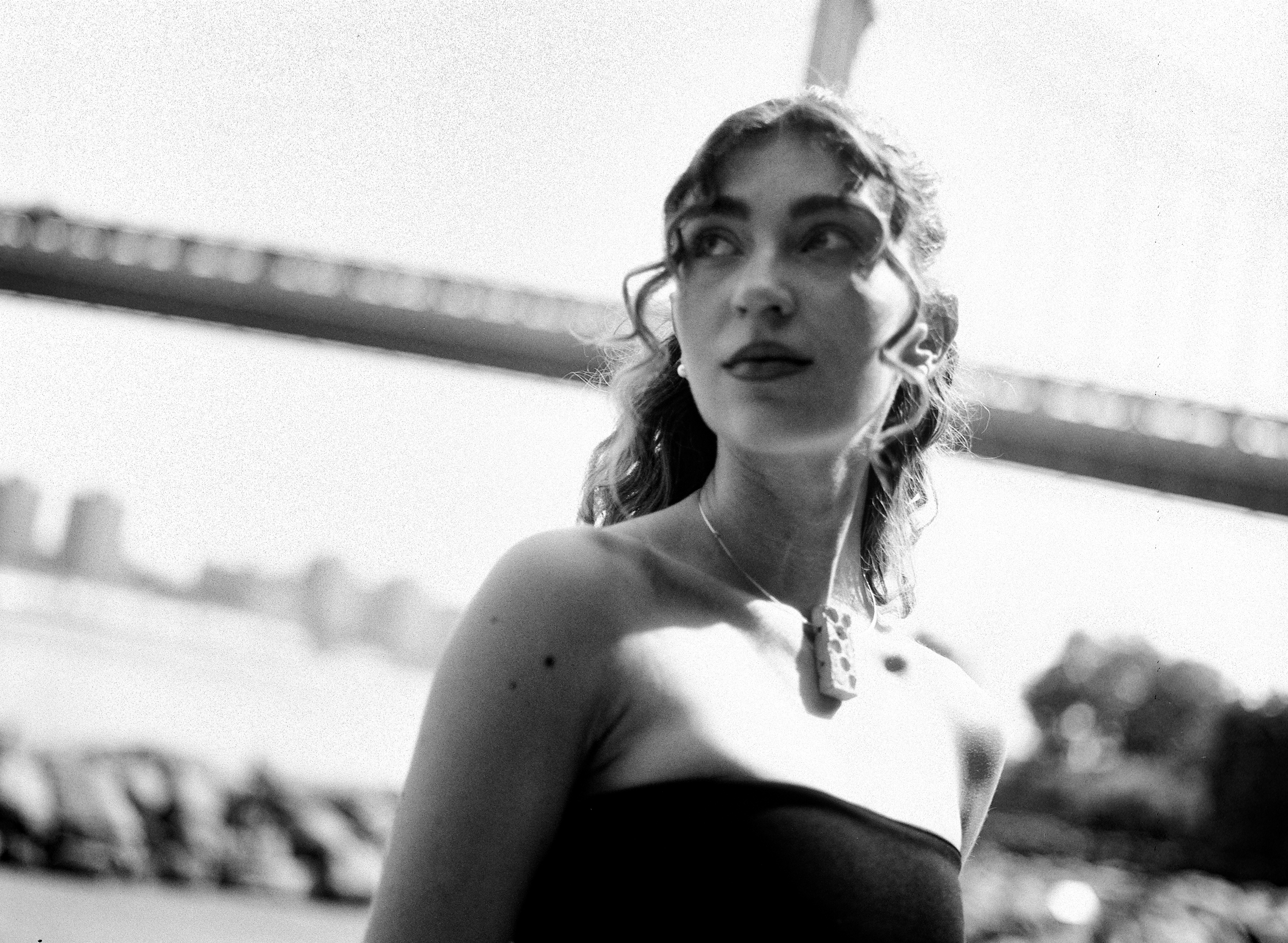
I ran into this lovely young woman taking some personal shots for social media in my neighborhood in Brooklyn. She noticed I had a Hasselblad and we ended up doing a handful of shots. She knew the camera and after exchanging instagram information I learned her name is Chiara and she is a professional model in Italy. Even before knowing that about her, I was feeling a bit nervous, having shot very few portraits at that point in my development and ended up making a number of mistakes, including forgetting I was using a 645 back and framing the first three or four shots for a full square 6×6 frame. Chiara was sweet and game, and was patient while I reloaded to the only other film I happened to have on hand, Rollei Ortho 25. While I really like Ortho 25, I would have been happier to have something faster to shoot at a more forgiving f stop depth of field-wise. I think my plan that morning was to grab some carefully composed cityscapes to see how Ortho 25 looked on architecture, but I couldn’t pass up the chance to try shooting some fairly glamorous looking portraits with the Hasselblad!
I was horrified when I saw the results from the lab — almost all of the shots I took of Chiara that day were borderline unusable. Some were composed for the wrong format, clipping or cutting off the top of her head, some were not great choices based on the angle of the sun which was high and hard that day, and all but one or two suffered from varying degrees of soft focus (which I subsequently discovered was due to a mechanical problem with the Hasselblad, more on that later.)
This shot and the feature shot are probably the best of the lot, the angle of the light that leaves her face in a bit of shadow and the softness combine to give them a glow that I didn’t get in the more properly focused shots that were in full hard front light. Despite their softness, there is a quality and mood to these shots that I like quite a bit. They feel like a 1950’s fashion or movie publicity photo. Sadly, with Chiara back in Italy, I won’t get another chance to do better shots of her any time soon, but with all of my subsequent practice shooting portraits, I’ll be ready.

This photo is from the first day I deliberately took the Hasselblad out in NYC to try my hand at some medium format street portraits. This was after spending a couple of months building up my skills and confidence on the Leica. It was a warm midsummer evening and the Brooklyn Bridge Park was mellow and lovely and full of nice people who were happy to let me take a few shots. Some of them were very curious about the unusual camera, a few were familiar with it, including a young photographer excited to see the camera that went to the Moon. Toward the end of the roll, I ran into Barbara & Alan, a very arresting looking pair enjoying the park. They were nice enough to let me take a few shots, and exchange Instagram information, where I learned that Barbara is a model in her native Russia. Ok, not every one I run into in my neighborhood is a professional model, but it is New York!
Here, with the narrow depth of field of the Hasselblad 80mm Planar, I had to make a choice between focusing on either Alan or Barbara and there was something very moody about Alan’s look that drew my focus. I might have shifted my position to an angle where I could get both of them in focus, but I’m not sure that little soulful moment would have lasted. I have a couple of other shots with them where they are both sharp, but this one has the most interesting emotional pull for me.
NOTE: Even after focusing on Alan, this shot feels a little softer than I should have been able to get with a Zeiss/Hasselblad lens. This roll of film led me to undertake an investigation of the focus mechanics of the Hasselblad 500CM, and I discovered that the camera has a backfocus problem when shooting at closer distances. If you look at the featured image, you’ll see that Chiara’s hair is sharp while her eyes and face are a little soft. I hadn’t discovered the backfocus issue while doing landscapes in Canada because almost everything was more or less at infinity and/or I was shooting in conditions and at stops where I had more depth of field. And if neither of those factors were true, I simply assumed the soft focus was just another operator error/fuck up on my part. So thanks to my uptight Protestant guilt ethic upbringing, it took me a lot longer and a lot more blown shots to figure it out than it otherwise might have.

This shot from the October No Kings Protest in NYC has a lot going for it — you get a sense of the energy of the crowd, the scale of the event with the faces, bodies and signs filling nearly every bit of space in the lower half of the frame, and a feel for the location approaching Times Square from the north. But it’s not just a random crowd shot — I love the determined scowl on the man in the foreground, frame right, and feel like there could be an amazing photo making him the main subject. But that’s where things start to fall apart for me; he’s just a little soft compared to a woman who is 5 or 10 feet deeper in the frame and pulls focus both literally and figuratively without adding significant interest. As I recall, I was trying to zone focus with the Voigtlander Color Skopar 28mm, f3.5, but the situation was so dynamic and fast moving that I was always chasing shots instead of making them. In terms of the composition, I didn’t manage to include his full protest sign in the frame while having more than enough architecture and skyline than I need to make the point we are in Times Square. I like the man’s ‘rule of thirds’ position frame right, but I think I would have done better to lower the camera or tilt down a bit to get the sign and make sure he was sharp — in that crowd I don’t think I would have noticed that woman’s face through the finder, but if I had properly composed and focused on the man, I’m not sure she would still be a distraction.
All easier said than done in the heat of the moment. This was an early attempt at a more documentary style shooting a giant protest march, and I was definitely finding my way. I think there will be more to follow…

This was from Washington Square Park during the late afternoon ‘shift change’ on Halloween as the citywide celebration was switching from families with small children with full bags of candy heading home for dinner to young adults in search of other kinds of fun who would continue the festivities deep into the night. The park was hopping and there was a street party going with a full sound system and DJ set up, and lots of young dancers having a wonderful time. Two young men particularly caught my eye, dancing on a granite park bench just behind the DJ, and I did a series of shots trying to capture the joy and energy and movement of their dancing. Shooting people dancing was something of a new challenge and learning to time my shots where I’d see their faces or capture a pose will be an acquired skill. The light was also dropping quickly as one of the dancers decided to jump over the DJ’s table and move out into the crowd. I saw it happening and swung, shot & prayed. I think it comes really close to capturing the vibrant energy of the moment as my moving, panning camera tracks the young man as he flew through the air — you can see the motion blur on the people in the background. But unfortunately I don’t think I was in quite the right spot to make him stand out and ‘pop’ as much as I would have liked — his clothing is dark and so is most of the background, so it’s all a bit of a dark swirl. I think it might work better in a series with some of the other shots I took that night as opposed to as a standalone, but most of them suffer from similar issues. Street dancing is fun to watch, but not always easy to shoot!
There are some common themes here — focus, exposure and framing/composition. One might ask ‘what else is there?’ And I guess that’s the real burning question — what is that hard to quantify quality that separates the merely competent from the interesting, the good or the great? What makes up the photographer’s vision/gift of seeing the world just a little differently than the rest of us mere mortals? I guess these photos have a tiny little grain or spark of something I find at least interesting, if only to me. But that hope & aspiration is offset by gnawing doubts about the technical flaws, or worse, by my fear that whatever glimmer I might see in my photos is just me getting high on my own supply…
As I put this post together, I also saw a pattern emerging — most of these photos that I keep thinking about are almost all early attempts to try something new or different that I hadn’t tried before. As I got better at shooting in a certain style or environment, I no longer have the same excitement or attachment to my ‘near misses’. Despite their flaws, these early efforts at something new or untried made me feel that I might be on to something if I kept going. And that’s how it goes for photos from the Bin of Ambivalence, I treasure them and have feelings of doubt and insecurity about them all at the same time. And so I go through that cycle of falling in and out of love with them over and over, lather, rinse repeat. Despite — or maybe in a few cases because of — their shortcomings.
I suppose that spark or glimmer is what we’re all chasing when we go out and shoot. I’m confident I’ll keep getting better at the technical aspects of making photos as I get more knowledge, experience and ‘muscle memory.’ I’m also confident I’ll still be plagued by love & doubt about whether my photos or my photography are worthy. If I ever stop having those doubts, I’ll no longer be able to improve and that would be time to stop trying to do photography. Happily, I have a very long way to go before that happens!
Share this post:

Comments
No comments found